Types of Angles
In this lesson, you will learn
- what an angle is: two arms that meet at a vertex
- the 7 types of angles based on their measure, from the zero angle to the full rotation angle
- positive and negative angles, and pairs of angles: adjacent, complementary, supplementary and vertical
- the names of the angles formed when a transversal cuts two parallel lines
What Is an Angle?
There are many different types of angles and these can be classified based on the following characteristics.
- Magnitude of the angle
- Rotation of the angle
- A pair of angles
- Angles formed when a transversal cuts two parallel lines
First, let us see what an angle is and then we will show all the different types of angles.
An angle is formed when two rays, also called arms of the angle, meet at a common endpoint called the vertex of the angle.
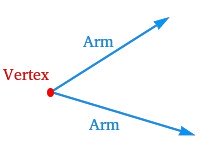
In the figure above, the vertex is shown with a red dot and the arms are shown in blue.
What is the common endpoint of the two arms of an angle called?
Show answer
The vertex. The two arms (rays) start from the vertex.
Classification of Angles Based on Their Magnitude
We will define the basic angles. Here is a list of 7 types of angles based on the magnitude of the angle.
- Acute angle
- Right angle
- Obtuse angle
- Straight angle
- Reflex angle
- Full rotation angle
- Zero angle
Study the images carefully so you understand them and then be able to recognize these basic angles quickly.
Acute angle
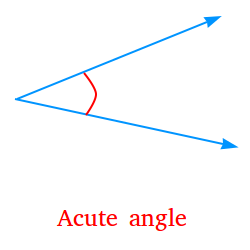
An angle whose measure is more than 0 degrees but less than 90 degrees is an acute angle. For example, if the magnitude of an angle is 89 degrees, the angle is acute. The angle below is an acute angle.
Right angle
An angle whose measure is exactly 90 degrees. The following is a right angle.

Obtuse angle
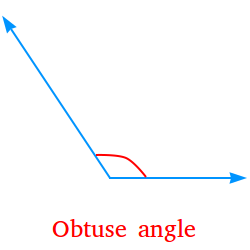
An angle whose measure is bigger than 90 degrees but less than 180 degrees is an obtuse angle. Thus, it is between 90 degrees and 180 degrees. For example, if the measure of an angle is 150 degrees, the angle is obtuse. The following is an obtuse angle.
Straight angle
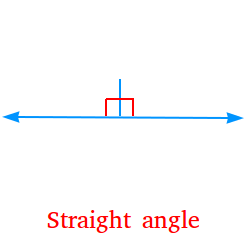
An angle whose measure is exactly 180 degrees. Thus, a straight angle looks like a straight line. The following is a straight angle.
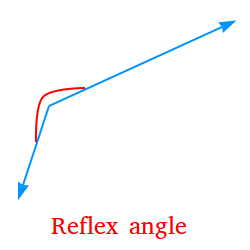
Reflex angle
An angle whose measure is bigger than 180 degrees but less than 360 degrees. For example, if the measure of an angle is 235 degrees, the angle is a reflex angle. The following is a reflex angle.
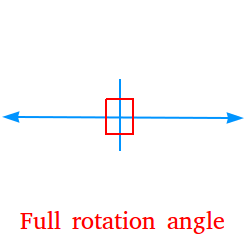
Full rotation angle
An angle whose measure is exactly 360 degrees is a full rotation angle. A full rotation angle consists of 4 right angles. The following is a full rotation angle.
Zero angle
An angle whose measure is exactly 0 degrees is a zero angle. A zero degree angle has one arm lying on top of the other, pointing in the same direction. The following is a zero degree angle.

- 120 is bigger than 90, so the angle is not acute or right.
- 120 is less than 180, so the angle is not straight or reflex.
- An angle between 90 degrees and 180 degrees is obtuse.
An angle of 120 degrees is an obtuse angle.
Calling every big angle obtuse. An obtuse angle is less than 180 degrees. An angle of 235 degrees is bigger than a straight angle, so it is a reflex angle.
What type of angle measures 300 degrees?
Show answer
A reflex angle. 300 is bigger than 180 and less than 360.
Interactive Angle Explorer: Build Any Angle
Move the slider, type a measure or pick a button to see the angle and its type. Then switch to the drawing challenge and draw the angle you are asked for.
Current angle: 0° (zero angle)
Draw an angle of 90°
Classification of Angles Based on the Rotation of the Angle
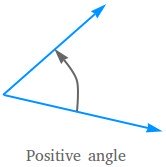
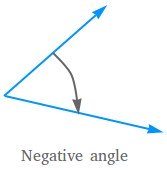
Two types of angles are formed when the angle is either measured in a counterclockwise direction or a clockwise direction.
If we measure an angle counterclockwise, or opposite to the direction the hands of a clock move, the angle is a positive angle. The angle below is a positive angle.
If we measure an angle clockwise, or in the same direction the hands of a clock move, the angle is a negative angle. The angle below is a negative angle.
The minute hand of a clock turns from 12 to 3. Is the angle it turns through positive or negative?
Show answer
Negative. The hands of a clock turn clockwise, and an angle measured clockwise is a negative angle.
Types of Angles Based on a Pair of Angles
Here is a list of 4 types of angles based on a pair of angles.
- Adjacent angles
- Complementary angles
- Supplementary angles
- Vertical angles
Adjacent angles
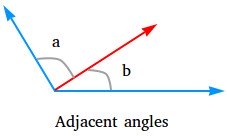
Angles with a common vertex and one common side are called adjacent angles.
∠a and ∠b are adjacent angles and the common side is red.
Complementary angles
Two angles whose measures add to 90 degrees are complementary angles. Angle x and angle y shown below are complementary angles because together they form a right angle.
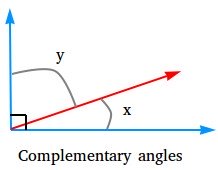
For example, suppose angle x is equal to 30 degrees and angle y is equal to 60 degrees. Since 30 degrees + 60 degrees = 90 degrees, angle x is the complement of angle y (another way to say they are complementary).
Note that angle x and angle y do not have to be adjacent to be complementary as long as they add up to 90 degrees.
Supplementary angles
Two angles whose measures add to 180 degrees are supplementary angles. Angle c and angle d shown below are supplementary angles because together they form a straight angle.
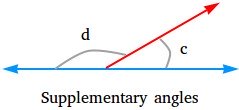
For example, suppose angle c is equal to 70 degrees and angle d is equal to 110 degrees. Since 70 degrees + 110 degrees = 180 degrees, angle c is the supplement of angle d (another way to say they are supplementary).
Vertical angles
When two lines cross, the angles that are opposite each other are called vertical angles or opposite angles. They have a common vertex, and their sides are formed by the same two lines. Angle α (alpha) and angle θ (theta) are vertical angles.
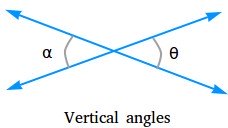
Vertical angles always have the same measure. If angle α is 40 degrees, then angle θ is also 40 degrees.
- Supplementary angles add to 180 degrees: c + d = 180.
- Subtract: d = 180 − 65 = 115.
- Check: 65 + 115 = 180.
Angle d measures 115 degrees.
Mixing up complementary and supplementary. Complementary angles add to 90 degrees, and supplementary angles add to 180 degrees. In the alphabet, C comes before S, just as 90 comes before 180.
What is the complement of an angle of 25 degrees?
Show answer
65 degrees. Complementary angles add to 90 degrees, and 90 − 25 = 65.
Angles Formed When a Transversal Cuts Two Parallel Lines
When two parallel lines are crossed by a third line (a transversal), 8 angles are formed. Take a look at the following figure.
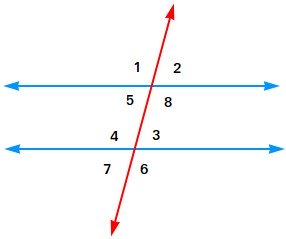
Angles 3, 4, 5, 8 are interior angles
Angles 1, 2, 6, 7 are exterior angles
Alternate interior angles
Alternate interior angles are pairs of interior angles on opposite sides of the transversal.
For instance, angle 3 and angle 5 are alternate interior angles. Angle 4 and angle 8 are also alternate interior angles.
Alternate exterior angles
Alternate exterior angles are pairs of exterior angles on opposite sides of the transversal.
Angle 2 and angle 7 are alternate exterior angles.
Corresponding angles
Pairs of angles that are in similar positions are corresponding angles.
Angle 3 and angle 2 are corresponding angles.
Angle 5 and angle 7 are corresponding angles.
When the two lines are parallel, alternate interior angles are equal, alternate exterior angles are equal, and corresponding angles are equal.
In the figure, which angle forms a pair of alternate exterior angles with angle 1?
Show answer
Angle 6. Angles 1 and 6 are both exterior angles, and they are on opposite sides of the transversal.
Here we go! Study the types of angles carefully. This is where any serious study of geometry begins.
Summary
- An angle is made of two arms (rays) that meet at a common endpoint, the vertex.
- By measure: zero (0°), acute (between 0° and 90°), right (90°), obtuse (between 90° and 180°), straight (180°), reflex (between 180° and 360°) and full rotation (360°).
- An angle measured counterclockwise is positive; an angle measured clockwise is negative.
- Adjacent angles share a vertex and a side. Complementary angles add to 90°, supplementary angles add to 180°, and vertical angles are equal.
- A transversal that cuts two parallel lines forms interior and exterior angles, and pairs of alternate interior, alternate exterior and corresponding angles.
Test Yourself: Interactive 10-Question Quiz
Now check what you learned. Every answer is explained, and each time you play you get new questions.
Quiz Complete!