Exponents
Exponents
In this lesson, you will learn
- what an exponent is and how to read it
- which number is the base and which is the exponent
- why −26 and (−2)6 give different answers
- how to raise a fraction to a power
What Is an Exponent?
Exponents can make your math problems a lot easier to handle. Simply put, it is a shortcut for multiplying numbers over and over again.
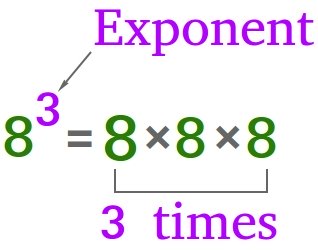
Look at the following multiplication problem:
8 × 8 × 8 × 8 × 8 × 8
Instead of multiplying 8 six times by itself, we can just write 86 and it will mean the same thing.
When reading 86, we say eight to the sixth power or eight to the power of six.
In a similar way, 12 × 12 × 12 × 12 × 12 × 12 × 12 × 12 × 12 × 12 = 1210
In 1210, 12 is called the base and 10 is called the exponent.
Write 3 × 3 × 3 × 3 using an exponent.
Show answer
34. The base 3 is written four times, so the exponent is 4.
Understanding Exponents with an Interactive Lesson and Practice
Change the base and the exponent to see the repeated multiplication. Then practice building and naming exponents.
Explore: an exponent is repeated multiplication
Use a base from 1 to 10 and an exponent from 0 to 10.
Practice: build it and name it
Practice complete!
Other Examples of Exponents
53 = 5 × 5 × 5
94 = 9 × 9 × 9 × 9
72 = 7 × 7
66 = 6 × 6 × 6 × 6 × 6 × 6
28 = 2 × 2 × 2 × 2 × 2 × 2 × 2 × 2
In general,
In one of the examples above, it says 72 = 7 × 7
What would you say 71 is equal to?
For 72, you wrote down 7 twice.
Therefore, for 71, you will write down 7 once and of course there is no need to have a multiplication sign.
71 = 7
Any number to the power of 1 is the number itself: a1 = a.
Multiplying the base by the exponent. 53 is not 5 × 3 = 15. It is 5 × 5 × 5 = 125.
- The base is 3 and the exponent is 4, so write 3 four times: 3 × 3 × 3 × 3.
- Multiply from left to right: 3 × 3 = 9.
- 9 × 3 = 27.
- 27 × 3 = 81.
34 = 81
What is the value of 25?
Show answer
32. 2 × 2 × 2 × 2 × 2 = 4 × 2 × 2 × 2 = 8 × 2 × 2 = 16 × 2 = 32.
Common Pitfalls to Avoid when Working with Exponents
What is −26 equal to?
Is it equal to −2 × −2 × −2 × −2 × −2 × −2 ?
Or is it equal to −(2 × 2 × 2 × 2 × 2 × 2) ?
It is equal to −(2 × 2 × 2 × 2 × 2 × 2) = −(26) = −64
However, (−2)6 is a different story.
(−2)6 = (−2) × (−2) × (−2) × (−2) × (−2) × (−2) = − × − × − × − × − × − × 2 × 2 × 2 × 2 × 2 × 2
Notice that − × − = +
So, − × − × − × − × − × − × 2 × 2 × 2 × 2 × 2 × 2 = + × + × + × 26
Note that + × + = +
(−2)6 = +26
In (−2)6, the exponent is even. Change it to any odd number and the answer will be negative.
(−2)7 = (−2) × (−2) × (−2) × (−2) × (−2) × (−2) × (−2) = − × − × − × − × − × − × − × 2 × 2 × 2 × 2 × 2 × 2 × 2
− × − × − × − × − × − × − × 2 × 2 × 2 × 2 × 2 × 2 × 2 = + × + × + × − × 27
+ × + × + × − × 27 = + × − × 27
Note that + × − = −
+ × − × 27 = −27
In −26, the exponent applies only to the 2, and the minus sign is put in front at the end. In (−2)6, the parentheses make the exponent apply to −2.
What are −32 and (−3)2?
Show answer
−32 = −9 and (−3)2 = 9. −32 = −(3 × 3) = −9, but (−3)2 = (−3) × (−3) = 9.
Important Observations about Exponents
In these observations, a is a positive number.
- −an is always negative.
- (−a)n is either negative or positive. It is positive if n is an even number. It is negative if n is an odd number.
- −an is not always equal to (−a)n
- −an may be equal to (−a)n only when n is an odd number.
Is (−5)3 positive or negative?
Show answer
Negative: (−5)3 = −125. The exponent 3 is odd, so the answer is negative. It is also equal to −53.
What If the Base Is a Fraction?
When the base is a fraction it is common to use parentheses as shown below:

The last expression above is also equal to 827
What is (12)3?
Show answer
18. 12 × 12 × 12 = 1 × 1 × 12 × 2 × 2 = 18.
Summary
- An exponent is a shortcut for multiplying the same number over and over: yn means n copies of y multiplied together.
- In 1210, 12 is the base and 10 is the exponent; we read it "twelve to the tenth power".
- Any number to the power of 1 is the number itself.
- −an and (−a)n are different: with parentheses, the negative sign is part of the base.
- A negative base gives a positive answer for an even exponent and a negative answer for an odd exponent.
Test Yourself: 10-Question Quiz
Now check what you learned. Every answer is explained, and each time you play you get new questions.
Quiz Complete!
Keep learning